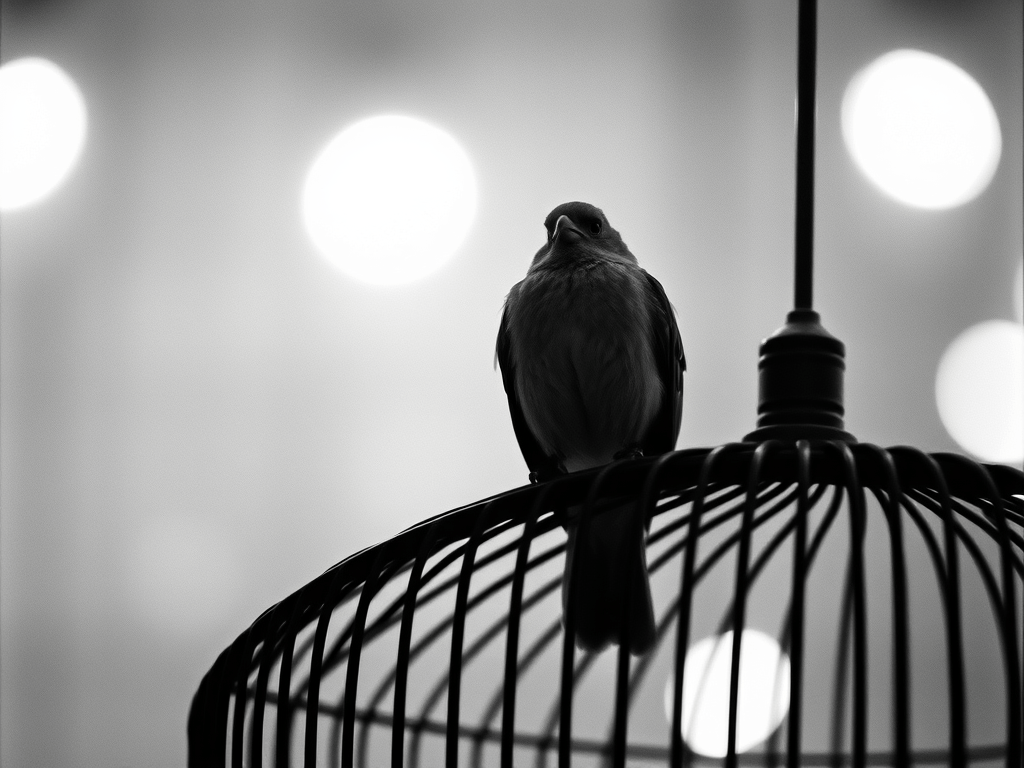
I lay awake at 4AM, reflecting on the people who have passed through my life. I thought of them as birds in cages. First, I took them in. Then, I sang to them, hoping they might learn to sing as well. Finally, I opened the cage to let them fly free. But as I pondered this analogy, a question emerged: Can you really teach a bird to sing?
It’s a simple question, but its implications run deep. Can we teach someone to express themselves, to create, or to find their own voice? Or are these things that can only come from within? We might show the way, offer guidance, but ultimately, every bird has its own song, its own voice—something that can’t be given, only uncovered.
The Spark of True Creation
This reminds me of a scene from I, Robot, where Detective Spooner asks a robot: “Can you write a symphony? Can you turn a canvas into a beautiful masterpiece?” The robot’s reply is simple, cutting: “Can you?”
At first glance, it might seem that humans have the edge here—that creativity is something distinctly ours. But the robot’s response points to an uncomfortable truth: creativity isn’t guaranteed simply because we’re human. The ability to create something meaningful, to bring beauty into the world, isn’t a given—it’s an act of courage, of vulnerability, and ultimately, of self-discovery. In a way, we are all like the birds, searching for our own song.
Influence vs. Autonomy: The Role of the Guide
When I think about those I’ve tried to guide, I realize that my role was never to give them a song. I couldn’t teach them to sing because their voice was already there, waiting to be found. What I could do, perhaps, was inspire them to listen to it, to trust it, and to let it out. But the song itself, the symphony of their own creation—that was always theirs, and theirs alone.
True influence isn’t about imparting a formula or handing over a blueprint. It’s about creating a space where the other person feels safe enough to explore, to take risks, and, ultimately, to find their own way. The art of guidance, then, is not about directing someone’s path but clearing the obstacles that prevent them from discovering it for themselves.
Can You Teach Creativity?
This question is particularly relevant in a world increasingly dominated by artificial intelligence and automation. We can program a machine to produce something that looks like art, or that sounds like music. But can we teach it to “sing” in the way a bird does, with a voice uniquely its own?
Perhaps the answer lies not in the ability to produce but in the intent and authenticity behind it. A machine can replicate patterns, analyze data, and even compose a tune. But the courage to sing—the desire to express something personal and true—is a uniquely human trait. It’s the reason why, despite the advances in technology, we still find ourselves captivated by the works of others, drawn to the authenticity of a human voice, a brushstroke, a melody. True creativity can’t be taught; it has to be discovered.
Conclusion: Finding Your Song
As I reflect on this analogy, I come to realize that life, in its truest form, is a journey toward finding our own song. We may encounter teachers, mentors, or friends who show us glimpses of what’s possible. But the song, the art, the creation—that is ours alone.
Disco E! is a place where creativity meets curiosity, where we explore art, science, and philosophy not as isolated concepts, but as parts of a deeper quest for self-expression. Here, I hope to invite others to find their own voice, to recognize the beauty of their own song, and to see the value in asking the hard questions.
Can you teach a bird to sing? Maybe not. But you can help it find the courage to open its beak and let out the song that was always within.




 DISCO E!
Leave a comment